Back in June I attended The AI Summit London 2026 at Tobacco Dock as part of London Tech Week.
This isn’t going to be a talk-by-talk recap, I went to a mixture of sessions across the Headliners and Creative AI tracks and, as usual with conferences, some stuck with me much more than others.
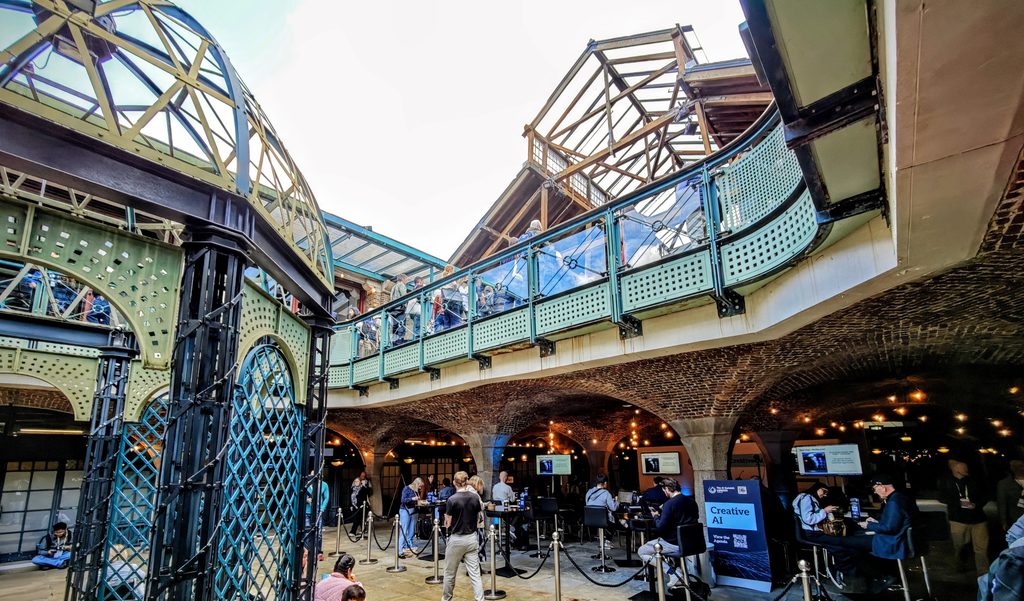
Firstly though, Tobacco Dock is a very cool conference venue. Lots of exposed brick, old timber and interesting spaces, which made a nice contrast to spending two days talking about AI 😄.
I also had the (much) cheaper Tobacco Dock Campus ticket, which gave me access to the Headliners stage, exhibition and expo stages, plus the Creative AI track. It turned out to be fantastic value. For the talks I wanted to see I never really felt like I was attending a cut-down version of the conference.
Here are the things I found most interesting.
Agents are automation with judgement
One of the sessions I enjoyed was AI in Action: From Idea to Agent in Under 25 Minutes, where Tom Hewitson built an agent live on stage based on a problem suggested by the audience.
One line I noted down was:
Agents are automation with judgement.
I really liked this as a simple way of thinking about where agents make sense.
A lot of workflows don’t require judgement. If normal deterministic automation can solve the problem reliably, making it agentic potentially just adds complexity and unpredictability.
This came up again in the Red Hat session AI That Fits Your Business, Not the Other Way Around. One of their slides described the difference nicely:
- Traditional RAG is more like a pipeline: retrieve relevant information, then use it to answer.
- An agent can go further by deciding what steps to take: planning, retrieving information, evaluating the result, taking an action, and repeating the loop if needed.
The latter is more capable, but also more expensive and more complicated. Red Hat also talked about using smaller models for parts of that loop rather than automatically throwing the biggest model at every task.
A nice general takeaway for me was: use as much AI as the problem actually needs.
Small aside: the live agent demo also finally sold me on trying Wispr Flow. I’d heard of it before, but seeing used in a live demo was very impressive. I still haven’t actually needed it yet as most of my dictation is into ChatGPT which does a great job of understanding me which Claude and Gemini often struggle with!
Human accountable for the loop
If I had been playing an AI Summit drinking game, take a shot if you hear “human in the loop” would definitely have been dangerous 🥴.
Which is probably why another phrase from the Humans at the Helm discussion panel stood out so much:
Human accountable for the loop.
I liked that distinction.
Putting a human somewhere in a workflow doesn’t automatically mean there is useful oversight, particularly if an AI system is making thousands or millions of decisions.
The more important questions are things like: Who designed the workflow? Who decides its limits? When should it escalate? Who is responsible if it goes wrong?
I particularly enjoyed Michael Jacobides‘ contributions to this panel. A wider theme from the discussion was that getting value from AI isn’t just a technology problem. Organisations may need to change processes, responsibilities and ways of working around it.
That probably ended up being one of my biggest takeaways from the conference.
Some Quality Engineering thoughts
None of the sessions I attended were specifically about software quality, but a few things connected quite naturally to Quality Engineering for me.
1. With agents, we’re testing a system rather than just an output
If an agent can retrieve information, make decisions, call tools, evaluate results and repeat, there are many more places where things can go wrong than simply getting a bad response from a model.
From a QE perspective this feels less like testing a clever chatbot and more like testing a distributed workflow.
The interesting failures could be in the context it was given, the tool it selected, the permissions it had, how it recovered from failure, whether it knew when to stop, or whether it escalated to a human at the right point.
2. Not everything should be agentic
This also feels like a quality decision rather than just an architecture decision.
If a problem can be solved with simple deterministic automation, that system is generally going to be easier to understand, test and make reliable.
Adding an LLM where judgement isn’t required potentially just creates another failure surface.
It reminded me of a point from an old testing conference I attended: an effective way to reduce bugs is simply to make the software simpler.
3. “Human accountable for the loop” feels familiar
Quality Engineering has spent a long time moving away from the idea that quality belongs to a tester at the end of the process.
Having a QA person somewhere in the lifecycle doesn’t magically make a product high quality, in the same way that having a theoretical “human in the loop” doesn’t automatically make an AI workflow safe.
Someone still needs to own how the whole system behaves.
That connection probably wasn’t intended by the panel, but it was one of the things I took away from it.
AI in healthcare and defence
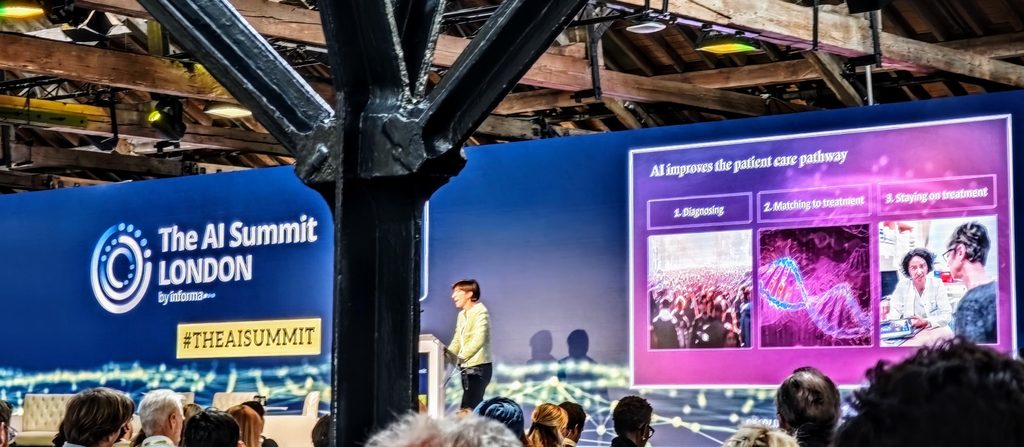
The Harnessing AI to Transform Patient Outcomes session from AstraZeneca was another one I found interesting.
One slide summarised five lessons from deploying AI at scale. A few phrases stuck with me:
- “Pilotitis is a disease.”
- “Governance is the lane, not the wall.”
- “The moat is the data, not the algo.”
- Clinician trust was described as one of the hardest problems.
I liked that these were mostly about actually getting AI adopted and useful rather than just model capability.
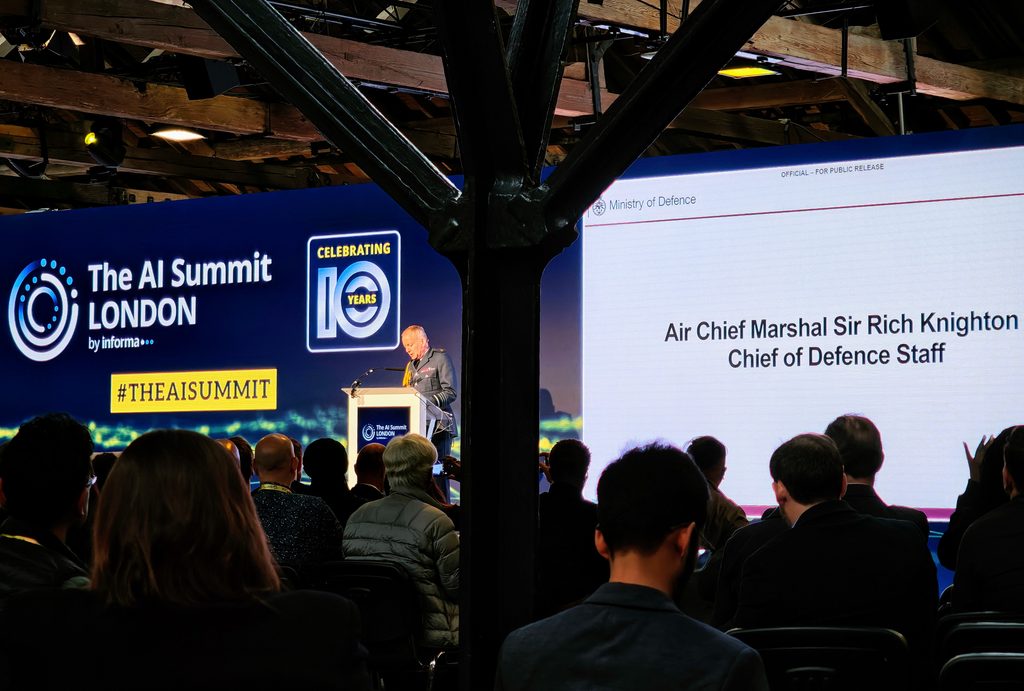
The talk from Chief of the Defence Staff, Sir Richard Knighton, was interesting for similar reasons.
It mentioned the (common military strategy) OODA Loop Observe, Orient, Decide, Act.
The idea was that AI can compress that decision cycle, letting organisations move from information to action more quickly.
There were also examples around dramatically shortening research and development cycles. The military application obviously has its own context, but the general concept of shortening the gap between learning something and acting on it was interesting.
Creative AI was… interesting
The Creative AI track was probably where I felt most conflicted.
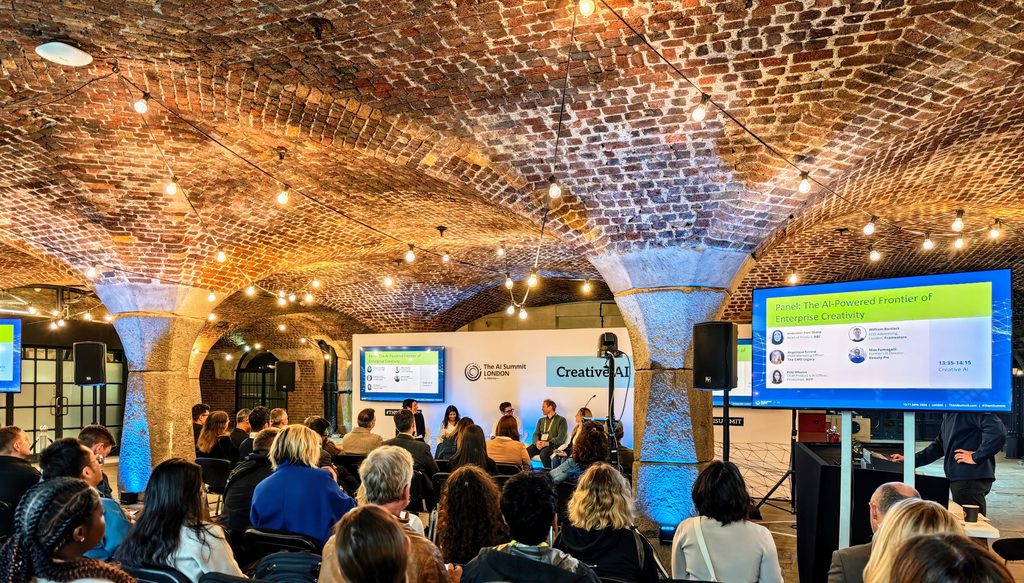
I attended various talks and panels covering AI use in film, TV, and advertising productions.
What surprised me was how much of the discussion seemed to begin from the assumption that generating footage, images and audio with AI was simply where production was going.
At one point there was a comparison between directing a traditional production and directing via prompts. I won’t attempt to quote it because I didn’t note the exact wording, but the comparison really stuck with me that it was implied to the director/producer it felt the same in both contexts.
As someone interested in photography, filmmaking, and occasionally acting, I found this fascinating but also a little uncomfortable.
There are clearly huge creative possibilities, especially for lower budget productions, but there are also questions around actors, crews, craft, ownership and perhaps most importantly whether audiences actually want some of this stuff.
Someone eventually raised the negative reaction consumers have had to some obviously AI-generated advertising, but other than that there didn’t appear to be much pushback on how things are evolving.
I probably left those sessions with more questions than answers.
Panels > presentations
Looking back, I think I got the most value from the panel discussions.
The presentations were useful for seeing concrete examples and demos, but the panels were where the uncertainty and disagreements came out.
Those discussions also produced most of the things I’m still thinking about months later:
- When does something actually need to be an agent?
- How do you test systems where behaviour isn’t completely deterministic?
- Where does accountability sit?
- How much complexity are we introducing in exchange for capability?
- And what happens when AI changes a workflow rather than simply making the existing one faster?
So despite attending a conference full of impressive models, demos and infrastructure, I think my biggest takeaway was actually about everything around the AI.
The workflow, the people, the process, the controls and deciding whether AI is even the right solution in the first place.