Author: admin

  • AI Summit London 2026 Notes

    Back in June I attended The AI Summit London 2026 at Tobacco Dock as part of London Tech Week.

    This isn’t going to be a talk-by-talk recap, I went to a mixture of sessions across the Headliners and Creative AI tracks and, as usual with conferences, some stuck with me much more than others.

    Firstly though, Tobacco Dock is a very cool conference venue. Lots of exposed brick, old timber and interesting spaces, which made a nice contrast to spending two days talking about AI 😄.

    I also had the (much) cheaper Tobacco Dock Campus ticket, which gave me access to the Headliners stage, exhibition and expo stages, plus the Creative AI track. It turned out to be fantastic value. For the talks I wanted to see I never really felt like I was attending a cut-down version of the conference.

    Here are the things I found most interesting.

    Agents are automation with judgement

    One of the sessions I enjoyed was AI in Action: From Idea to Agent in Under 25 Minutes, where Tom Hewitson built an agent live on stage based on a problem suggested by the audience.

    One line I noted down was:

    Agents are automation with judgement.

    I really liked this as a simple way of thinking about where agents make sense.

    A lot of workflows don’t require judgement. If normal deterministic automation can solve the problem reliably, making it agentic potentially just adds complexity and unpredictability.

    This came up again in the Red Hat session AI That Fits Your Business, Not the Other Way Around. One of their slides described the difference nicely:

    • Traditional RAG is more like a pipeline: retrieve relevant information, then use it to answer.
    • An agent can go further by deciding what steps to take: planning, retrieving information, evaluating the result, taking an action, and repeating the loop if needed.

    The latter is more capable, but also more expensive and more complicated. Red Hat also talked about using smaller models for parts of that loop rather than automatically throwing the biggest model at every task.

    A nice general takeaway for me was: use as much AI as the problem actually needs.

    Small aside: the live agent demo also finally sold me on trying Wispr Flow. I’d heard of it before, but seeing used in a live demo was very impressive. I still haven’t actually needed it yet as most of my dictation is into ChatGPT which does a great job of understanding me which Claude and Gemini often struggle with!

    Human accountable for the loop

    If I had been playing an AI Summit drinking game, take a shot if you hear “human in the loop” would definitely have been dangerous 🥴.

    Which is probably why another phrase from the Humans at the Helm discussion panel stood out so much:

    Human accountable for the loop.

    I liked that distinction.

    Putting a human somewhere in a workflow doesn’t automatically mean there is useful oversight, particularly if an AI system is making thousands or millions of decisions.

    The more important questions are things like: Who designed the workflow? Who decides its limits? When should it escalate? Who is responsible if it goes wrong?

    I particularly enjoyed Michael Jacobides‘ contributions to this panel. A wider theme from the discussion was that getting value from AI isn’t just a technology problem. Organisations may need to change processes, responsibilities and ways of working around it.

    That probably ended up being one of my biggest takeaways from the conference.

    Some Quality Engineering thoughts

    None of the sessions I attended were specifically about software quality, but a few things connected quite naturally to Quality Engineering for me.

    1. With agents, we’re testing a system rather than just an output

    If an agent can retrieve information, make decisions, call tools, evaluate results and repeat, there are many more places where things can go wrong than simply getting a bad response from a model.

    From a QE perspective this feels less like testing a clever chatbot and more like testing a distributed workflow.

    The interesting failures could be in the context it was given, the tool it selected, the permissions it had, how it recovered from failure, whether it knew when to stop, or whether it escalated to a human at the right point.

    2. Not everything should be agentic

    This also feels like a quality decision rather than just an architecture decision.

    If a problem can be solved with simple deterministic automation, that system is generally going to be easier to understand, test and make reliable.

    Adding an LLM where judgement isn’t required potentially just creates another failure surface.

    It reminded me of a point from an old testing conference I attended: an effective way to reduce bugs is simply to make the software simpler.

    3. “Human accountable for the loop” feels familiar

    Quality Engineering has spent a long time moving away from the idea that quality belongs to a tester at the end of the process.

    Having a QA person somewhere in the lifecycle doesn’t magically make a product high quality, in the same way that having a theoretical “human in the loop” doesn’t automatically make an AI workflow safe.

    Someone still needs to own how the whole system behaves.

    That connection probably wasn’t intended by the panel, but it was one of the things I took away from it.

    AI in healthcare and defence
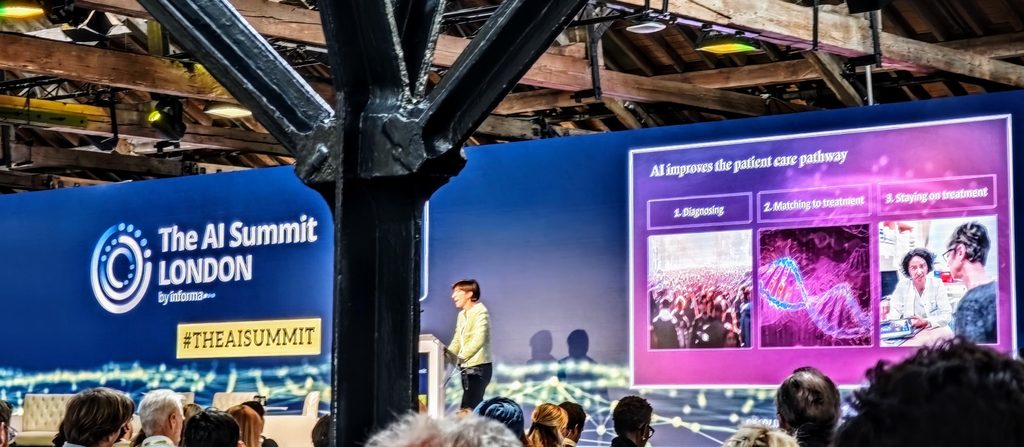
    The Harnessing AI to Transform Patient Outcomes session from AstraZeneca was another one I found interesting.

    One slide summarised five lessons from deploying AI at scale. A few phrases stuck with me:

    • “Pilotitis is a disease.”
    • “Governance is the lane, not the wall.”
    • “The moat is the data, not the algo.”
    • Clinician trust was described as one of the hardest problems.

    I liked that these were mostly about actually getting AI adopted and useful rather than just model capability.
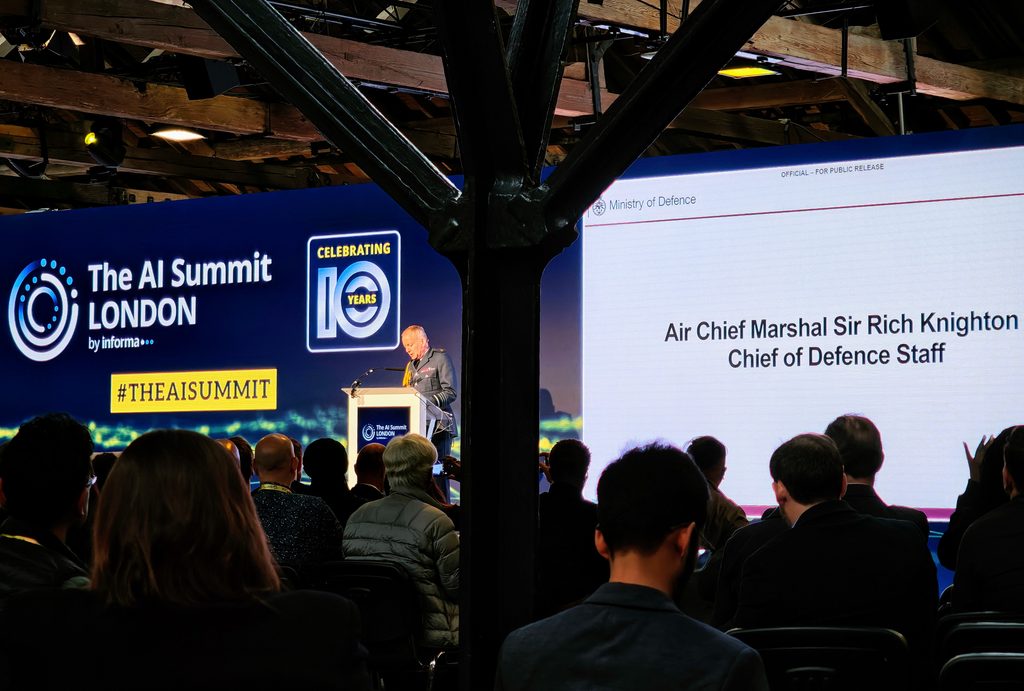
    The talk from Chief of the Defence Staff, Sir Richard Knighton, was interesting for similar reasons.

    It mentioned the (common military strategy) OODA Loop Observe, Orient, Decide, Act.

    The idea was that AI can compress that decision cycle, letting organisations move from information to action more quickly.

    There were also examples around dramatically shortening research and development cycles. The military application obviously has its own context, but the general concept of shortening the gap between learning something and acting on it was interesting.

    Creative AI was… interesting

    The Creative AI track was probably where I felt most conflicted.
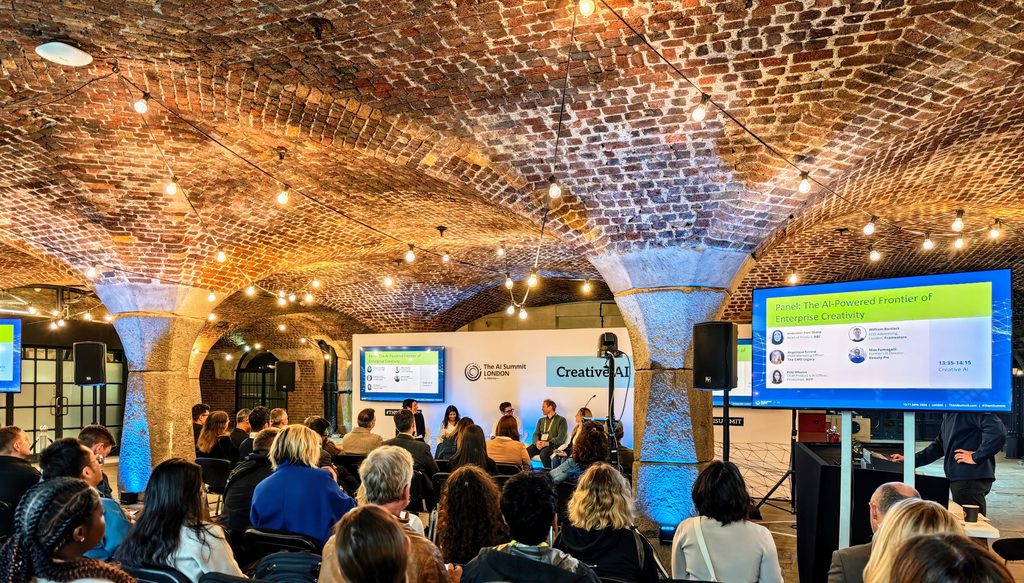
    I attended various talks and panels covering AI use in film, TV, and advertising productions.

    What surprised me was how much of the discussion seemed to begin from the assumption that generating footage, images and audio with AI was simply where production was going.

    At one point there was a comparison between directing a traditional production and directing via prompts. I won’t attempt to quote it because I didn’t note the exact wording, but the comparison really stuck with me that it was implied to the director/producer it felt the same in both contexts.

    As someone interested in photography, filmmaking, and occasionally acting, I found this fascinating but also a little uncomfortable.

    There are clearly huge creative possibilities, especially for lower budget productions, but there are also questions around actors, crews, craft, ownership and perhaps most importantly whether audiences actually want some of this stuff.

    Someone eventually raised the negative reaction consumers have had to some obviously AI-generated advertising, but other than that there didn’t appear to be much pushback on how things are evolving.

    I probably left those sessions with more questions than answers.

    Panels > presentations

    Looking back, I think I got the most value from the panel discussions.

    The presentations were useful for seeing concrete examples and demos, but the panels were where the uncertainty and disagreements came out.

    Those discussions also produced most of the things I’m still thinking about months later:

    • When does something actually need to be an agent?
    • How do you test systems where behaviour isn’t completely deterministic?
    • Where does accountability sit?
    • How much complexity are we introducing in exchange for capability?
    • And what happens when AI changes a workflow rather than simply making the existing one faster?

    So despite attending a conference full of impressive models, demos and infrastructure, I think my biggest takeaway was actually about everything around the AI.

    The workflow, the people, the process, the controls and deciding whether AI is even the right solution in the first place.


  • LeadDev NYC 2024 Notes

    Back in September 2024 I attended LeadDev New York 2024 at the Javits Center.

    The venue was gigantic, and the conference itself was really well run. As with most conferences, there were talks I didn’t get much from, but there were also a few sessions and discussions that gave me plenty to think about afterwards and I’ve wrote up my notes from that time below.

    The Javits Center venue was massive and was a cool place to experience. Setting sun at the end of day 1.

    At the time I was working on WooCommerce Core, so unsurprisingly a lot of the things that caught my attention were around engineering processes, quality, releases and incidents.

    These were my main takeaways.

    Incident response is a process you need to practise

    One of the most useful discussions actually happened around an Incident.io demo rather than in a traditional conference talk.

    A point that came up was that during an incident, people forget the process.

    That immediately made sense to me. Incidents are chaotic. From my own background in emergency search and rescue, and also from reading The Checklist Manifesto, I already knew how useful checklists and predefined procedures can be when people are under pressure.

    The discussion also covered having a dedicated place to coordinate an incident and using automation to prompt people through the process. Specifically using their tool, but I believe you can make a difference just by making using your existing tool, for example if you have Slack, create or designate a channel for announcing all incidents, then spin up a fresh new channel for the new incident (no need to overthink what to call it, that naming convention should already be defined in the incident response process) and run through the incident checklists and discussions there.

    I particularly liked the idea that once you automate parts of your incident response, you are effectively encoding the process. If someone changes that automation later, the change becomes explicit rather than the real process gradually drifting away from whatever is written in a document somewhere.

    Another feature that caught my attention was the ability to run simulated incidents.

    Again, this reminded me of search and rescue training. Simulations let you discover where a process breaks down without having to wait for a real emergency to find out. Run a debrief afterwards and iterate on the process.

    It made me wonder whether software teams should do more of this. We practise what to do in the event of a fire in buildings, but plenty of engineering teams have fairly detailed incident procedures that aren’t really tested until something goes wrong for real.

    Status pages

    The Incident.io discussion also got me thinking about status pages.

    At the time, WooCommerce didn’t really have a dedicated public status page. There were various places where users could get updates, but nothing that felt like the obvious destination for things like known issues, incidents in progress or service problems. It’s not typical to have a status page for something that is a release artefact rather than a service but when the learned behaviour of users when something goes wrong (especially when they have not knowingly made any changes) is to seek out a status page then why not have one.

    I thought a WooCommerce status page could potentially include things like:

    • Known issues affecting releases
    • Incidents in progress (in this context, critical bugs without a fix yet)
    • Rollbacks or other important release information
    • Outages affecting hosted services or APIs

    There was also an interesting observation that a spike in people visiting your status page can itself be a signal that something is wrong, possibly before your normal monitoring has picked it up.

    I still really like that idea: users collectively noticing something is wrong can become another observability signal.

    Metrics are only useful if you can do something with them

    Another discussion was about engineering metrics.

    A phrase I wrote down was:

    Metrics without agency are bad.

    One attendee from Meta talked about focusing more on what was actually delivered than on things like lines of code or raw contribution counts, and looking at measures of collaboration such as code review activity instead.

    That led into another takeaway for me: we should automate the collection of metrics wherever we reasonably can.

    I spoke to the CEO of Swarmia during the conference and got a quick demo of their product. What interested me wasn’t really another dashboard, but the possibility of automatically collecting information that engineering and quality teams otherwise spend time manually assembling.

    The goal shouldn’t be to produce more metrics. It should be to spend less time collecting them and more time interpreting them and deciding what to do next.

    That feels particularly relevant to Quality Engineering, where it is very easy to end up maintaining reports and dashboards without stopping to ask whether anyone can actually act on what they show.

    If you don’t target enterprise, somebody else will

    One of the talks I wasn’t expecting to get much from was a sponsor presentation about making products more “enterprise-ready”.

    It was actually really interesting.

    One of the speaker’s arguments was essentially:

    If you don’t target enterprise, somebody else will.

    They used Slack and Microsoft Teams as an example, arguing that Teams was able to gain ground partly because Microsoft was prepared to meet enterprise requirements that Slack hadn’t initially prioritised.

    Whether or not that particular comparison is quite that simple, the broader point made sense.

    Enterprise users often care about things that aren’t particularly glamorous:

    SAML login, audit logs, retention policies, compliance, security controls, accessibility and so on.

    Those things might not make an exciting product launch, but for some customers they determine whether they can use your product at all.

    It was also another reminder that accessibility isn’t only a quality or ethical concern. In some markets, particularly government and larger enterprise organisations, it can be a requirement for doing business.

    Roadmaps, estimates and admitting uncertainty

    Another talk I enjoyed was Dates and deadlines… it’s complicated.

    The speaker used the deliberately provocative line:

    “Roadmap is a lie.”

    The point wasn’t that roadmaps are useless, but that we often communicate them as though we know much more than we really do.

    We pretend we know all of the work that will be required, how many people it will take and exactly when it will be finished.

    Instead, the talk suggested thinking in terms of a hypothesis roadmap: define what you think will happen, the outcome you’re trying to achieve and how confident you are in it.

    The part I liked most was the suggestion of adding confidence levels and context to goals and estimates.

    Instead of:

    This will take eight weeks.

    Something closer to:

    We currently estimate 8–12 weeks, with 60% confidence, based on what we know today.

    That feels both more honest and more useful.

    It also applies well beyond project management. In software quality we constantly make assessments based on incomplete information: how risky is this change, how likely is this problem to affect users, how confident are we that we’ve tested enough?

    Being explicit about confidence rather than disguising uncertainty as certainty seems like a good habit.

    Everyone was dealing with the same challenges

    One of the final talks looked at the state of engineering leadership in 2024.

    There were plenty of survey statistics, but what stuck with me wasn’t any individual number.

    It was that engineering leaders across the industry seemed to be dealing with many of the same problems: layoffs, previous over-hiring, AI hype, increased workloads and managers being given wider responsibilities.

    None of those things were particularly positive, but there was something strangely reassuring about hearing that the challenges weren’t unique to one company or team.

    Final thoughts

    Overall I’d rate LeadDev NYC highly.

    Some of my most useful takeaways didn’t actually come from the headline talks. They came from smaller discussions, demos and conversations that made me connect something back to problems I was already thinking about.

    The ideas I’ve probably carried forward most are:

    • All aspects of incident response and how it feels so closely related to quality engineering, if it hasn’t already quality should be shifting right to be more a part of it. Practise (test?!) incident response rather than assuming the process will work when you need it.
    • Automate gathering metrics so humans can spend their time interpreting them.
    • Enterprise requirements that look boring can actually be strategically important.
    • Be more explicit about uncertainty and confidence.
    • Don’t collect measurements unless somebody can actually do something with them.

    Nice bonus is a lot of the talks are public on YouTube, here is the playlist:
    https://youtube.com/playlist?list=PLBzScQzZ83I_teVy_lIyNGAy1FMNaAFfS&si=tB7Oe0sp5yrSkMid

Share with